Article counts
Citable (146)
Developed (1,125)
Developing (7,366)
Stubs (7,656)
(16,424 total)
|
The most exciting phrase to hear in science, the one that heralds new discoveries, is not “Eureka!” (I found it!) but “That’s funny …”
— Anonymous, attributed to Isaac Asimov
—add a quotation about knowledge or writing
|
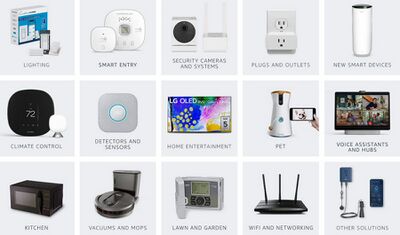 Categories of smart home devices shown on Amazon's website in April 2023. The phrase smart home refers to home automation devices that have internet access. Home automation, a broader category, includes any device that can be monitored or controlled via wireless radio signals, not just those having internet access. Whether the device is powered by the electrical grid or by battery, if it uses the home Wi-Fi network and if an internet logon needs to be created to use it, then it is smart home technology.
Collectively, all the smart home devices on every home's Wi-Fi network helps to make up what is called the Internet of Things (IoT), a huge sea of sensors and control devices across the world that are capable of being accessed from afar via the internet. One of the key reasons such devices need internet access is so that the manufacturer can periodically download updated firmware to the device to keep it up-to-date. However, being available via the internet also means that such devices are, potentially, available for spying or hacking. Today, homes may contain dozens or even hundreds of such devices, and consumers may enjoy their benefits while knowing little about how they work, or even realizing that they are present.
Not all home automation is "smart"
Many remotely controllable devices do not require internet access. They may instead have physical control devices that use either RF (“Radio Frequency”) or IR (“Infrared”) beams, two different kinds of energy used in remote controls to communicate commands. Non-"smart" home automation may also present security risks, because the control signals can be hijacked by bad actors with the right signaling equipment. Garage door openers are of particular note in this regard. Modern automobiles, in fact, are full of automation similar to home automation, and cars are hackable by bad actors in a number of ways. See Wikipedia's Automotive hacking article for more information.
Incompatibility hassles
At present, consumers must make sure that the smart device they wish to use is specified to be compatible whichever phone/tablet operating system they use (Apple vs. Android). Since smart home products emerged in the absence of any standard, a morass of competing methods for networking, control and monitoring now exist. For some products, consumers may need to buy an expensive hub, or bridge, a device that is specific to one vendor. Products made by different manufacturers but performing the same function are typically not interoperable. Consumers often need to open a different app on their smartphone or tablet in order to control devices by each manufacturer. This may make it too expensive and awkward to try out competing devices, leaving consumers stuck with the product they bought originally or else having to add yet more apps to their phones.
Security concerns
Security for smart home products has been uneven and sometimes seriously inadequate. Smart thermostats which can monitor whether a home's occupants are present or not, entry-way locks, robotic vacuums that work with a map of the house, and other smart home devices can present very real dangers if hackers can access their data.
Matter, an emerging standard
Matter is emerging standard in 2023 intended to increase security, reliability and inter-operability of smart-home devices. About ten years ago, industry consortiums formed to work on standards for smart home device communications, and their underlying wireless communications, which would make it possible for products from all vendors to work together seamlessly and provide fast performance, privacy, and security and would work even if there is not connection to the outside internet (i.e., no connection to "the cloud" or to servers).
|
